Publications & projects
Research
Full record, citation counts, and co-author list on
Google Scholar.
Code for most projects is on GitHub.
Conference presentation
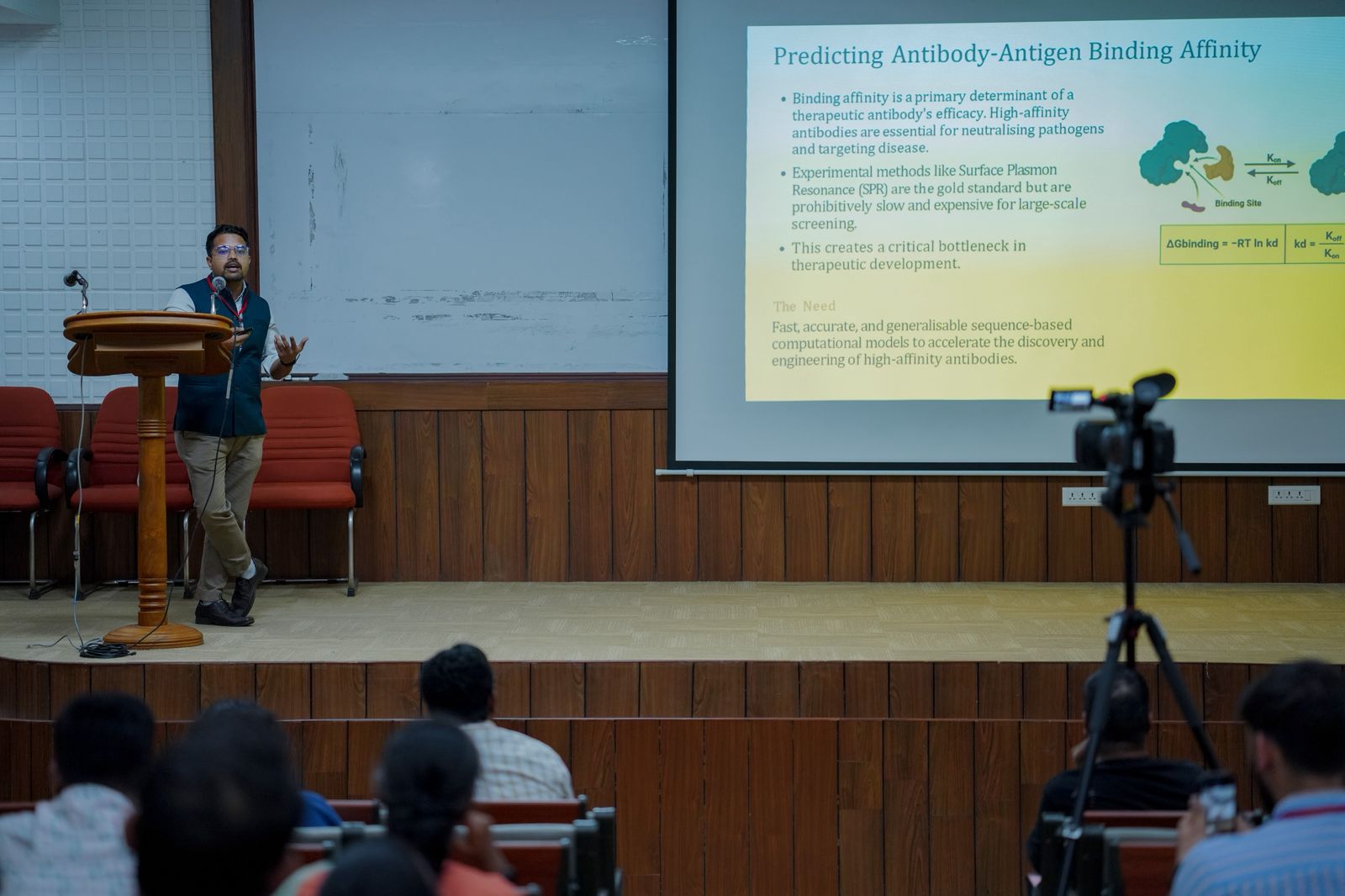
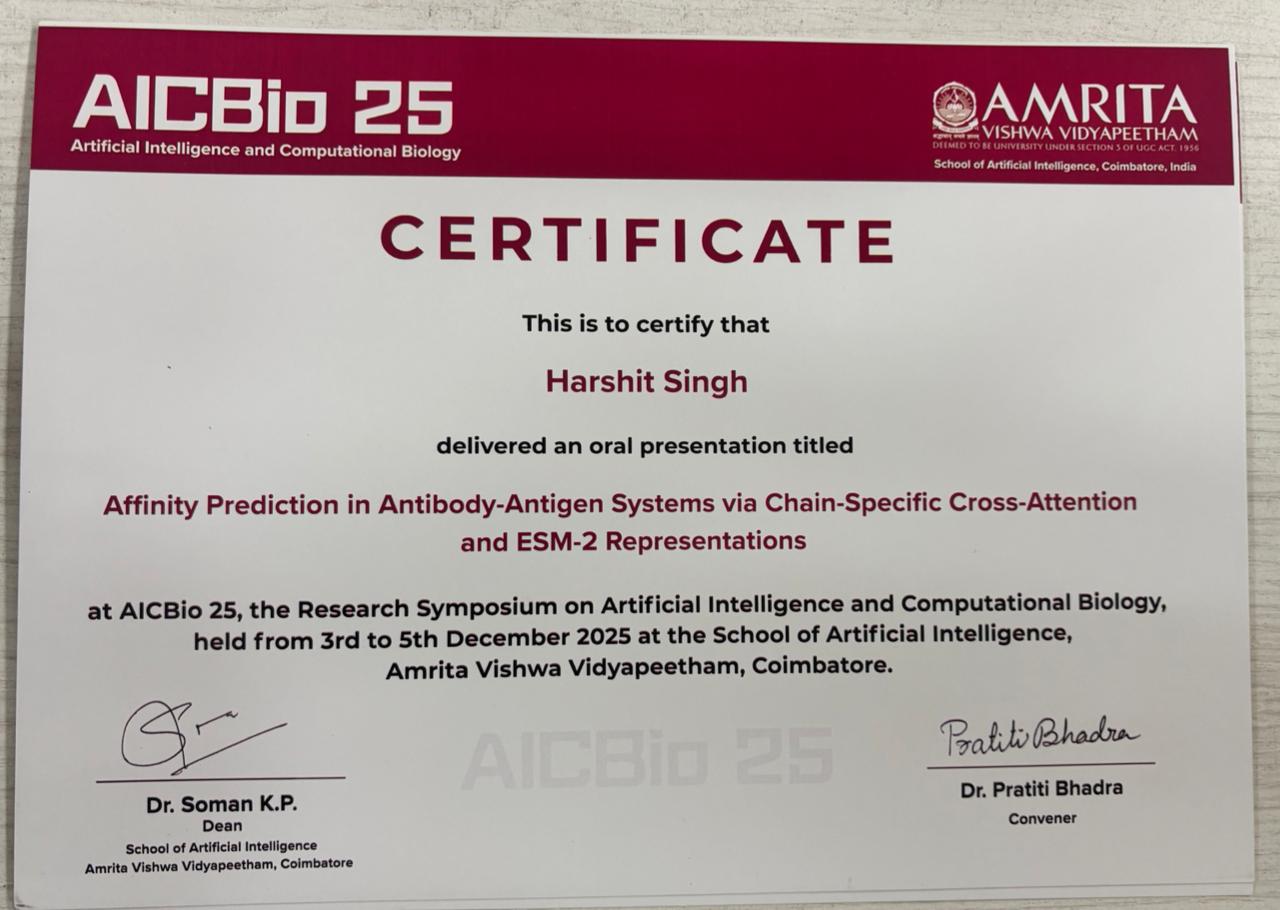
AICBio 25 Oral Presentation
Delivered an oral presentation titled Affinity Prediction in Antibody-Antigen
Systems via Chain-Specific Cross-Attention and ESM-2 Representations at
AICBio 25, held from December 3-5, 2025 at Amrita Vishwa Vidyapeetham,
Coimbatore.
Professional updates
Selected LinkedIn Posts
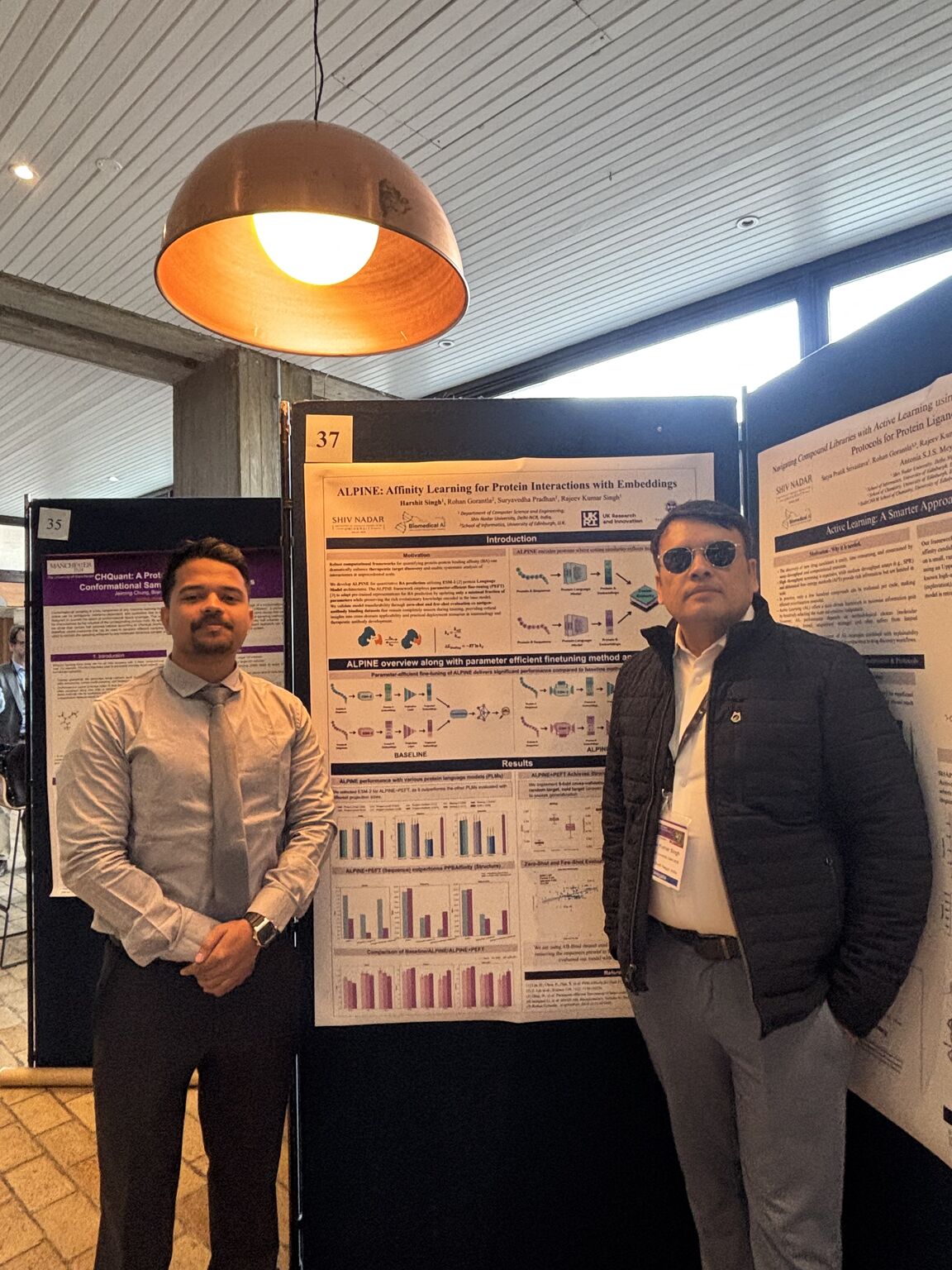
AI Chem 25 · Cambridge
8th RSC-CICAG / RSC BMCS Artificial Intelligence in Chemistry Symposium
Delighted to have presented our work, ALPINE: Affinity Learning for
Protein Interactions with Embeddings, as a poster and flash oral talk at
the 8th RSC-CICAG / RSC BMCS AI in Chemistry Symposium, hosted at the
University of Cambridge. ALPINE adapts parameter-efficient fine-tuning on top
of ESM-2 protein language model embeddings to predict protein-protein binding
affinity without relying on structural data, keeping the model lightweight
enough to fine-tune on a single GPU while remaining competitive with
structure-aware baselines. It was a privilege to discuss the framework with
researchers from across the AI-in-chemistry community, get feedback on the
zero-shot and few-shot embedding evaluations, and see where structure-free
affinity models like this one fit alongside heavier biophysical simulation
approaches. Grateful to my co-authors and to Shiv Nadar University, the UK
Research and Innovation council, and the University of Edinburgh's School of
Informatics for supporting this collaboration.
Open LinkedIn post
Springer Nature
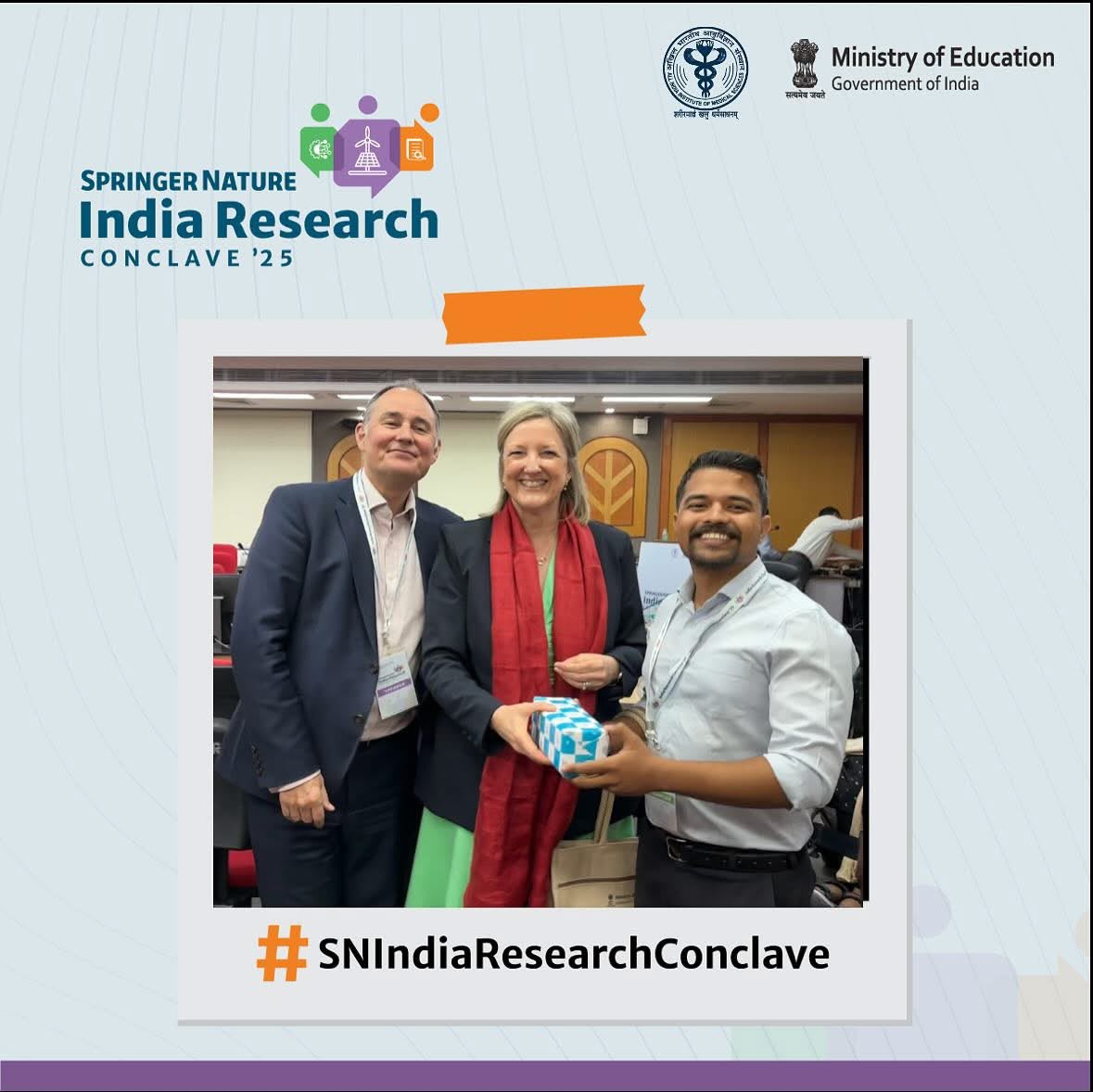
India Research Conclave 2025
Honoured to represent Shiv Nadar University as a Springer Nature
Research Ambassador at the Springer Nature India Research Conclave
2025, held in partnership with India's Ministry of Education. As part of the
ambassador program I help connect Springer Nature's publishing and research
services with early-career researchers on campus — from open-access policy
and reproducibility standards to manuscript preparation and journal selection
— while also getting a front-row view of how a major scientific publisher is
thinking about AI's role in peer review, discovery, and scholarly
communication. The conclave brought together researchers, institutional
leaders, and policymakers from across the country to discuss the future of
Indian research output, and it was a great opportunity to talk shop about
where explainable ML for drug discovery fits into that larger picture.
Open LinkedIn post
Presentations & service
Talks, Posters and Reviewing
- Flash oral, 8th RSC-CICAG / RSC BMCS AI in Chemistry Symposium (Churchill College, Cambridge)
- Oral presentations: AICBio '25 and Novartis BR RISING 2026
- Accepted poster: BiotechX Europe 2026
- Reviewer: AI4DD Workshop and GlobalSouthAI Workshop, NeurIPS 2026
October 2026
LEAF: Do LLM Proposers Improve Budgeted Molecular Search?
NeurIPS 2026 Workshop
- Strictly budget-matched protocol isolating LLM evolutionary proposers against a genetic algorithm and random search over a 30k ionizable-lipid space.
- No LLM proposer improved Pareto hypervolume. The negative result is the pre-registered primary finding.
- Accepted at a NeurIPS 2026 workshop.
LLM proposersmolecular searchnegative result
doi.org/10.64898/2026.10.06.756984 — bioRxiv
October 2026
CLARA: Compound Library Active Learning with Reasoning Agents
- Co-author. Language-model strategy control for batch active learning over four protein targets.
- A GPT agent outperforms random sampling across 40 matched campaigns.
active learningLLM agents
doi.org/10.64898/2026.10.05.756921 — bioRxiv
September 2026
GRASP: Graph Representation Learning with Assay Supervision for Molecular Properties
- 93.5M-parameter graph Transformer: replaced-token detection pretraining on ZINC20, then sparse multi-assay adaptation on 642 ChEMBL assays.
- Fine-tuned GRASP reaches mean MAE 0.374 on 23 cluster-held-out OpenADMET endpoints, versus 0.383 for CheMeleon and 0.408 for ECFP4-LightGBM.
- The intermediate ChEMBL stage improves 21 of 23 endpoints.
graph TransformerADMETself-supervised learning
doi.org/10.64898/2026.09.28.755019 — bioRxiv
August 2026
TabAL: Importance of Representation in Molecular Tabular Active Learning
NeurIPS 2026 Workshop (AgenticLS)
- Co-author. Representation choice (ECFP4 vs. RDKit2D) can reverse model rankings across scaffold-split ADMET tasks.
- Accepted at the AgenticLS workshop, NeurIPS 2026.
active learningADMETrepresentation
July 2026
Active Learning for Antibody Binding Affinity Prediction
ACML 2026 (Main Track)
- Gaussian-process active-learning benchmark across eight AbBiBench assays using ESM-2 650M embeddings.
- A Tanimoto-kernel GP with UCB acquisition reaches 67.3% mean Recall@2% versus 8.9% for random sampling under a fixed 10% budget.
- ESM-2 outperforms antibody-specific PLMs and classical featurizations. IG and KernelSHAP attributions are validated against crystal structures.
- Accepted at ACML 2026 (Main Track).
active learningGaussian ProcessSHAPESM-2
July 2026
The GRaM 2026 Competition and Warped-IFW Dataset
ICLR 2026 GRaM Workshop, PMLR
- Team contributor to a multi-institutional submission on ML surrogate modeling of transient flow.
- Published in PMLR as part of the ICLR 2026 GRaM Workshop.
surrogate modelingbenchmark
proceedings.mlr.press/v326/suk26a.html — PMLR
2026
SIMBA: Sequence-Based Prediction of Protein Binding Affinity and Mutation Effects
- Frozen ESM-2 with a fixed-size interface memory and Pairformer-style refinement predicts absolute ΔG and mutation effects without structure at inference.
- Evaluated under random, sequence-similarity and cold-target splits, with residue-level interface explanations.
- Under review.
ESM-2Pairformermutation effectsXAI
March 2026
Explainable Binding Affinity Prediction via Fine-tuned PLMs (BALM-PPI)
- Reframes binding affinity prediction as metric learning, projecting proteins into a shared latent space where cosine similarity correlates with experimental pKd.
- Fine-tunes an ESM-2 backbone with LoRA, training under 1% of parameters.
- Pearson r = 0.89 on the PPB-Affinity benchmark; zero-shot generalization to evolutionarily distant proteins (r = 0.61 at <30% identity).
- Uses Integrated Gradients to identify residue-level interaction hotspots that align with experimentally validated biophysics in enzyme–inhibitor and antibody–antigen systems.
- Presented as a poster and flash oral talk at the 8th AI in Chemistry Symposium, Cambridge University, UK. Under review at a Q1 journal.
LoRA / PEFTESM-2metric learningIntegrated Gradients
doi.org/10.64898/2026.03.30.715237 — bioRxiv
June 2026
Antibody–Antigen Affinity Prediction with Chain-Aware Protein Language Modeling (AbAffinity)
- A sequence-only, chain-aware three-stream architecture that keeps heavy chain, light chain, and antigen as distinct streams, avoiding the information collapse of single-representation antibody encoders.
- Combines frozen ESM-2 embeddings with CDR-focused pooling, heavy–light self-attention, adaptive fusion gating, and gated cross-attention, training only a compact interaction module.
- Strong, robust performance on SAAINT-DB under 10-fold cross-validation, including on novel antigens; outperforms recent sequence-based models on SAbDab, AB-Bind, and SKEMPI 2.0.
- Ablations confirm independent contributions from chain-specific representations, CDR-focused pooling, and the gated interaction pathway.
- Integrated Gradients attributions recover known paratope/epitope residues at structurally validated interfaces — an explainable, sequence-first option for antibody triage when structural data isn't available.
- Oral presentation at AICBio '25 and Novartis BR Rising. Under review at a Q1 journal.
antibody modelingESM-2gated cross-attentionXAI
doi.org/10.64898/2026.06.19.733375 — bioRxiv
November 2025
Ginkgo Antibody Developability Competition
Ginkgo Bioworks
- Contributed ML models predicting five biophysical properties: hydrophobicity, thermostability, self-association, expression titer, and polyreactivity.
- Analyzed out-of-distribution performance using a public training set of 246 clinical antibodies and a blinded test set of 80 diverse sequences.
- Formally acknowledged in the resulting study published in mAbs (Taylor & Francis).
antibody developabilityOOD evaluation
doi.org/10.1080/19420862.2026.2634216
September 2026
OpenADMET + ExpansionRx Blind Challenge (Small Molecule ADMET)
- Predictive models for 9 ADMET endpoints using real-world drug discovery data targeting RNA-mediated diseases (myotonic dystrophy, ALS, dementia).
- Spearman R = 0.5425 and Kendall's Tau = 0.3880 on the blinded, macro-averaged test split.
- Used community-standardized MA-RAE metrics to validate robustness across heterogeneous chemical spaces in an open-science benchmark.
ADMETsmall molecules
chemrxiv.org/doi/full/10.26434/chemrxiv.15009342/v3 — ChemRxiv
July 2025
Predictive Analysis of Liver Cirrhosis Stages: An Ensemble Learning Approach
- Compared SVM, decision tree, random forest, and additive tree models.
- Additive trees achieved 94% accuracy.
- Published in Springer Nature.
ensemble learninghealthcare ML
doi.org/10.1007/978-981-96-5210-56
June 2025
AI in Natural Language Processing: Techniques, Challenges, and Applications in Text and Speech Analysis
Book chapter — Artificial Intelligence and Machine Learning, RADemics Research Institute
NLPbook chapter
doi.org/10.71443/9788197282164-11
Ongoing
AbDev-X and Ongoing Work
- AbDev-X: biologically grounded multi-representation fusion for antibody developability, with leakage-free stacking and three-level explainability.
- LipidFlow-AL: flow-matching plus active learning for ionizable lipids.
- MolCausal: causal probing of molecular foundation models.
- Simplicity-vs-complexity benchmarks for binding affinity.
antibody developabilityflow matchingcausal probing
Earlier work
Encoding Audio with DWT-Base64 for QR Code Embedded Secure Transmission
January 2024
A robust audio watermarking scheme for QR-code-embedded transmission, covering data hiding, audio compression, and extraction.
Exploring Image De-Noising Techniques Through Histogram-Based De-Noising Methods
December 2023
Proposes a texture-enhanced image de-noising (TEID) method that pushes the gradient distribution of the de-noised image toward the estimated gradient distribution of the original.
Identifying Excellence in Citrus Fruit Image via Support Vector Machine Classifier
December 2023
A system for grading citrus size and bacterial spot defects using image processing.
Recognition of Sanskrit Characters Using Convolutional Neural Networks
September 2023
Addresses the challenges of Sanskrit's complex script and historical variation in writing styles.
Neural Network Based Prediction Model: A Banking System Perspective
September 2021 — DOGO RANGSANG Research Journal
Virtual Lab — eBOOTATHON 04
July – September 2020, launched by AKTU with IIT Kanpur
Experiments on beam deflection: comparing measured dial-gauge deflection against calculated values and evaluating Young's modulus.